|
Welcome!
Latest on Head Scab Risk in Kentucky
(FHB Risk Assessment - 05.13.2013) The FHB risk
in much of central and west KY continues to be moderate. Risk is
higher in east KY. Dry weather today through Wed will allow some
fields to be sprayed with a scab fungicide, assuming you are not
more than 5 days past the beginning of crop flowering (anthesis).
If your crop has been flowering for more than 5 days, harvest
restrictions for individual products will preclude you from
spraying. Plus, results would be very iffy. Research has shown
that Caramba, Proline and Prosaro are the preferred products for
suppressing FHB symptoms and DON contamination of grain.
Tebuconazole products used alone will not perform as well as the
recommended products. Any product that contains a strobilurin
should not be applied when there is a significant FHB risk due
to the potential to increase DON in harvested grain above that
of non-treated wheat. Fungicides containing a strobilurin do not
have Fusarium head blight (head scab) on the product label.
--Don Hershman, Extension Plant Pathologist,
University of Kentucky
For more details, go to the FHB Risk assessment tool at
http://www.wheatscab.psu.edu
|
Precision Technology Seminars
July 29-30, 2013
Cost: $25.00 per person (meals included)
Pre-Registration Required; Space is Limited
To register, contact Adam Andrews at
(502) 974-1121
or email your name and phone number to
adam@kycorn.org.
Read more
|
 |
Farmers Challenged to Support University
of Kentucky Wheat Research via Grain Donation
KySGGA will match funds
The Kentucky Small Grain Growers
Association (KySGGA) established a research fund at the
University of Kentucky (UK) last year to ensure the advancement
of production research crucial to Kentucky’s grain farmers. The
fund has received $18,000 to date from grower and private
company contributions and matching funds from KySGGA.
Chris Kummer, a Simpson Co. grain farmer, was the first to make
a contribution because he believes in the success of the UK’s
wheat research programs.
“Wheat and small grain production in Kentucky has made
tremendous strides the past few decades due to the talent and
dedication of UK’s research staff and their cooperation with
farmers and professionals,” said Kummer. “I wanted to invest in
the program to see that success continue for decades to come.”
The KySGGA has directed nearly $2 million in checkoff toward
small grain research. While annual research project grants to
several institutions remain a priority of KySGGA leadership,
establishment of a permanent research fund will guarantee that
small grain research will continue to be a priority at the
University of Kentucky.

“Our leadership has been extremely pleased with the quality of
research conducted at UK, and growers have benefited greatly
from the results,” said Kentucky Small Grain Promotion Council
Chairman Don Halcomb. “The fund will work only to improve our
successful partnership.”
Individual growers and businesses may donate to the fund, and
KySGGA will match the sum of donations up to $50,000. In
addition to cash, growers and businesses may make an above the
line deductible donation of grain. The fund must reach $50,000
before it can become an endowment, which is a goal of the
association.
“I’m hoping others will see the value of the UK small grain
research program, and I’m encouraging others to make that
investment in our future production,” challenged Kummer.
Donations of any size should be made directly to the University
of Kentucky College of Agriculture for the Kentucky Small Grains
Growers Association Research Fund.
Checks can be mailed to:
UK College of Agriculture
Marci Hicks, Director of Development
E S Good Barn
1451 University Drive
Lexington, KY 40546-0097
For more information on how to make a gift of grain, contact
Marci Hicks at 859.257.7200. For more information about the
fund, please contact KySGGA Executive Director Laura Knoth at
800.326.0906 or by email at
laura@kysmallgrains.org.
Call
for Research
KySGGA is now accepting research proposals for the 2013-2014
growing season through July 12. Projects should be geared to
research of small grain crops (wheat, barley, oats, rice, rye,
triticale) or of production/marketing issues and methods that
may benefit all Kentucky crop growers.
KySGGA leadership met in March to discuss research they would be
most interested in seeing. Suggestions included: swath control
for air seeders, irrigation, cover crops/crop mix, chemical
resistant weeds (i.e. chickweed), wheat growth regulators,
improvements in late-planted wheat, and crop modeling such as
water needs.
All interested investigators should
click here for
instructions and application forms. Any questions should be
directed to Jennifer Elwell at 502.921.2625 or
jennifer@kysmallgrains.org.
Agricultural Land Prices, Supply, Demand and Current Trends
Assistant
professor Cory Walters and Ph.D. student John Barnhart in the
University of Kentucky department of Agricultural Economics
recently released the following article regarding land value
research funded by the Kentucky Small Grain Growers Association
and Kentucky Corn Growers Association. This is the first article
of three that will be released this spring.
Farmland market price discovery is difficult due to many factors
influencing farmland market price (for example: parcel
production capabilities, size and shape) plus the fact that a
majority of transactions take place behind closed doors. What we
do know is that, over the past decade, average U.S. farmland
values have more than doubled (NASS, 2012). Particularly for
corn and soybean producing regions, farmland prices have risen
largely because of increased demand from market participants
attempting to capture financial gain through expected future
production profits and asset appreciation. Changes in factors
influencing farmland market values influence buyer and seller
decisions. The purpose of this article is to describe the
incentives faced by farmland buyers and sellers in a supply and
demand framework explaining the reasons why farmland values are
relatively high.
Read more
Financial Impacts from Farmland Value Declines by Various
Ownership Levels
Assistant
professor Cory Walters and Ph.D. student John Barnhart in the
University of Kentucky department of Agricultural Economics
recently released the following article regarding land value
research funded by the Kentucky Small Grain Growers Association
and Kentucky Corn Growers Association. This is the second article
of three that is being released this spring.
Long-term farm financial strength stemming from investment
decisions is a primary concern of
all producers, bankers, and the entire agricultural industry.
Farmland in Kentucky represents the
primary resource for producers to accumulate wealth and
represents, on average, 75% of producers’ assets (KFBM, 2012).
There are large differences in farmland as a percent of assets
across Kentucky producers, with a minimum of 13% and maximum of
99% (KFBM, 2012). Declines in farmland values have the potential
to reduce long-term farm financial strength (causing liquidation
in the extreme case) as well as producing negative indirect
impacts throughout the entire agricultural industry. In this
article, we examine farm financial impacts from farmland value
declines by various farmland ownership levels through key
financial ratios.
Read
more
Kentucky Farm featured on America's Heartland TV Show
 |
Peterson Farms of Loretto, Ky were
featured on a recent episode of America's Heartland,
showcasing their wheat, soybean and corn operation.
America's Heartland is in its 8th season and airs on
local PBS stations and RFD-TV.
View the episode. |
Is Wheat a Chronic Poison?
From
Best Food Facts "Food for Thought" Blog
A recent episode of
The View focused on a report from Dr. William Davis
that claimed wheat is a "perfect chronic poison" that stimulates
our appetites and ultimately, on average, makes us consume 440
more calories per day. In an age where paying attention
to calorie intake is essential, this is something that made our
ears perk up.
The basic idea is that over the last 50 years,
hybridization of the wheat grain has taken place to increase
crop yield and lengthen shelf life. To do this, a protein called
gliadin was added to the grain. The theory is that the higher
concentration of this protein has made wheat less digestible,
which causes an allergy.
According to
Dr. P. Stephen Baenziger, professor in the Department of
Agronomy and Horticulture at the University of Nebraska-Lincoln,
wheat is relatively higher in protein than other cereal grains
such as rice and corn and therefore, lower in carbohydrates. In
addition, Dr. Baenziger says that wheat from 100 years ago
exhibited the same qualities as modern wheat, so the assumption
that today’s wheat varieties create gluten sensitivity is
unfounded.
Read more
Kentucky Wheat Featured in UK mAGazine
Wheat
seed is not very big, but what it helps produce is huge.
Kentucky farmers, like the Hunts in Hopkinsville, plant that
tiny seed in their fields in mid-to-late October. By June, it
has developed into grain that helps fuel economies, create jobs,
build corporate partnerships, and most importantly, provide
nourishment to countless numbers of people every day in Kentucky
and across the nation.
When many people think about Kentucky agriculture, horses and
tobacco quickly come to mind, but the state boasts a significant
amount of wheat production. Kentucky ranked 16th in the nation
in winter wheat production in 2010, with growers producing 16.5
million bushels of the soft red winter wheat that provides flour
for cookies, cakes, pastries, breads, and crackers.
Kentucky producers started growing more wheat when
double-cropping it with soybeans became popular in the 1970s,
giving them the chance to get two crops from a field in one
growing season.
Read more
Additional News
KySGGA
News Archives |
|
Events
& Important Dates
UK Wheat Field Day
May 14, 2013
UKREC, Princeton, KY
2013 Small Grain Research Funding Proposals Due July 12
More
information
2013 Wheat Production Contest
Entry Deadline: July 24
View complete rules
from the University of Kentucky.
State awards are given to the highest yield in each division,
and area awards are given to the top entry (which was not a
state winner) in each of the four wheat production areas. Cash
awards from the Kentucky Small Grain Growers Association will be
made only to those who attend the Annual Awards Banquet at the
Kentucky Commodity Conference, January 17, 2014.
The producer with the highest yield may also be recognized at
the 2014 Commodity Classic in San Antonio, TX and participate in
Whayne Supply’s Best of the Best program.
Precision Technology Seminars
July 29-30, 2013
Cost: $25.00 per person (meals included)
Pre-Registration Required; Space is Limited
To register, contact Adam Andrews at
(502) 974-1121
or email your name and phone number to
adam@kycorn.org.
Read more
Certified Seed,
No Strings Attached
A
Kentucky-developed Soft Red Winter Wheat Variety
that offers farmers high performance and
more marketing flexibility at a great value
Find out more

Research Results
Review the results of KySGGA
funded research conducted in the 2011-2012
growing season.

2012 Annual Report
Kentucky
Wheat Facts
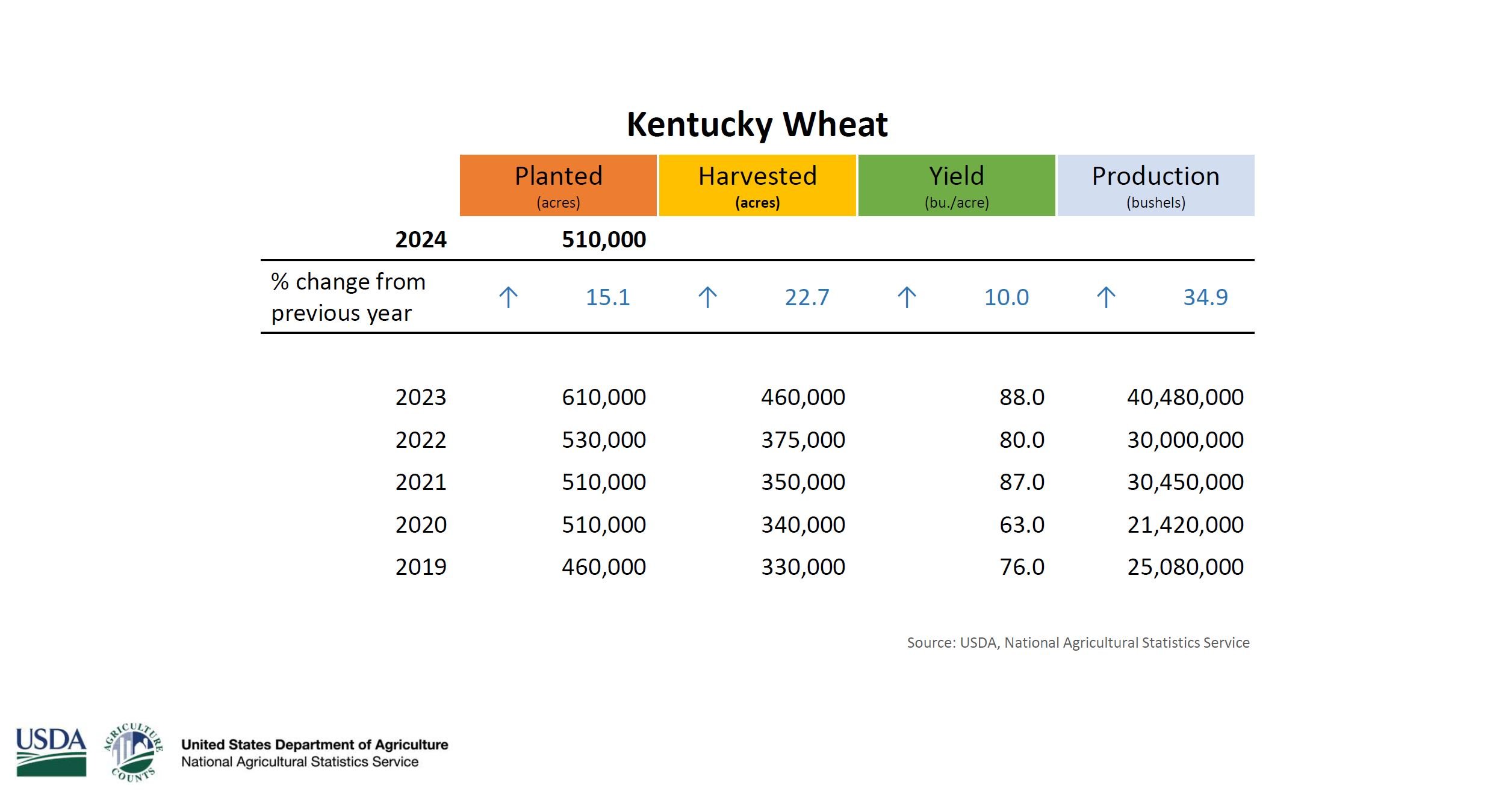
In 2012, the
Kentucky farmers harvested
29.14 million bushels of winter wheat
valued at $209.8 million. This was among the top 5 largest
wheat crops in Kentucky on record. Average yield was
63 bu/A.
In 2011, Kentucky
wheat brought
$199.2 million in cash receipts.
Source:
Kentucky Field Office of the USDA’s National
Agricultural Statistics Service
Soft red winter
wheat is grown in Kentucky. It is best suited for cakes,
pastries, cookies, crackers and cereals. All-purpose
flour is a mix of soft and hard wheat flours. There are
a number of mills and bakeries located in Kentucky due
to the close proximity of their raw ingredients.
Kentucky farmers
also produce about
600 thousand bushels of barley annually.
Rice, rye, oats, grain sorghum and triticale
are also produced in the state, but production
is not monitored.

Production Resources
UK Wheat Science Newsletter
UK Grain Crops Update
UK Grain Crops Extension HOME
|

KySGGA is a member of the
Kentucky
Livestock Coalition
|