
Impact of Environmental Conditions and Management Practices on Aphids and Hessian Fly in Kentucky Wheat
Nick Teets & Adeshina Adewinle
University of Kentucky, Lexington
Introduction
Aphids and Hessian fly are among the most economically important insect pests of winter wheat in Kentucky and across the United States. These pests reduce yield directly through feeding and indirectly through the transmission of plant viruses, particularly in the case of aphids (Royer et al., 2020; Perkins et al., 2018). Their population dynamics are strongly influenced by environmental conditions, especially temperature, which regulates development, reproduction, and seasonal activity.
In addition to temperature, planting date also remains one of the most critical management factors influencing pest pressure. Early planting exposes wheat to a higher risk of Hessian fly infestation before the fly-free date, whereas delayed planting can reduce Hessian fly pressure but may increase exposure to aphid colonization later in the season (Adewinle & Villanueva, 2025; Buntin et al., 2025; Buntin et al., 1990). As environmental conditions become more variable, understanding how temperature and plant timing interact to influence pest phenology is essential for improving management decisions.
In this second year of the project, we evaluated how temperature and accumulated degree-days shape the seasonal phenology of aphids and Hessian flies. We also examined how these dynamics interact with planting date and management practices, including seed treatment, to better inform integrated pest management (IPM) strategies in Kentucky wheat systems.
Materials and Methods
Field Monitoring and Environmental Data
During the 2024–2025 wheat growing season, we conducted field monitoring at the University of Kentucky Research and Education Center (UK-REC) in Princeton, KY, as well as selected commercial wheat fields.
Insect activity was monitored weekly throughout the growing season and off-season periods. We assessed Hessian fly and aphid populations using a combination of sampling methods, which including yellow sticky traps, pheromone traps (for adult male Hessian flies), sweep net sampling, and direct plant inspections. For plant sampling, we examined multiple plants within each plot to determine the presence of aphids, Hessian fly larvae, and plant damage symptoms.
Our experimental plots consisted of replicated seed treatments across multiple planting dates. Each treatment consisted of four replicated plots, thus allowing for comparison of pest pressure and plant response under different conditions.
We obtained daily temperature data from the Kentucky Mesonet station located at Princeton, KY. And then we used the data to calculate cumulative degree-days (base 4°C) to quantify heat accumulation throughout the season. Degree-day accumulation was then used to relate pest activity to environmental conditions and seasonal phenology.
Planting Date and Seed Treatment Experiments
Here, to evaluate the effects of management practices, we also planted wheat at multiple dates ranging from mid-September to early November. This allowed us to assess how planting timing influences pest pressure and crop performance.
Seed treatments in the field experiment included:
Fungicide-only treatment
Insecticide + fungicide treatment (imidacloprid-based)
We also conducted a laboratory experiment to determine the efficacy of seed treatments against aphids under controlled conditions. For this experiment, in addition to the two seed treatments listed above, we also included an untreated control to ensure laboratory conditions were favorable for aphid growth.
Each treatment was replicated across planting dates. Aphid populations were monitored at multiple 51 time points following infestation, and plant growth parameters, including plant height and biomass, 52 were measured at the end of the experiment.
Results and Discussion
Seasonal Phenology and Environmental Drivers
Here, pest activity closely followed seasonal temperature trends and cumulative degree-day accumulation (Figure 1). Hessian fly populations showed a pronounced increase during late spring to early summer, corresponding with periods of rapid heat accumulation. There was a rapid increase in Hessian fly abundance when the cumulative degree days reached ~1800. In contrast, aphid populations remained relatively low early in the season but increased later under favorable conditions, once cumulative degree days exceeded 4,000.
These patterns are consistent with temperature being a primary driver of pest phenology and support the use of degree-day models for predicting pest activity in wheat systems.
Pest activity patterns we observed in this study also emphasize the importance of planting date as a key management factor. Periods of high Hessian fly activity coincided with warmer conditions and increased degree-day accumulation, suggesting wheat planted earlier may be more exposed to infestation risk. Conversely, cooler conditions associated with typical fall planting windows likely contributed to reduced Hessian fly pressure.
For aphids, population increases later in the season indicate that delayed planting may shift exposure toward periods more favorable for aphid establishment. This highlights a potential trade-off, where avoiding Hessian fly through delayed planting may increase the risk of aphid infestation.
Effect of Planting Date and Seed Treatment on Yield
Wheat yield presented here was strongly influenced by planting date and seed treatment (Figure 2). Earlier planting dates resulted in higher yields, particularly when insecticide + fungicide seed treatment was applied. We obtained the highest yields in mid-September and early October plantings, while yields declined substantially in later planting dates.
The effect of seed treatment on yields also varied with planting date. In earlier plantings, insecticide-treated plots produced higher yields compared to fungicide-only treatments, which indicates that protection against early-season pest pressure contributed to improved crop performance. However, in later planting dates, overall yield declined regardless of treatment, indicating that delayed planting may limit yield potential due to shortened growing conditions and possible winter injuries.
Here, the results show the importance of planting dates as a key management decision. Early planting can improve yield potential but may increase exposure to Hessian fly (see figure 1), while delayed planting reduces Hessian fly risk but may result in lower yields and potential aphid pressure. Integrating planting date decisions with seed treatment strategies can help balance these trade-offs and improve overall wheat production.
Effect of Seed Treatment on Aphid Populations
In a laboratory assessment, seed treatment had a strong and consistent effect on aphid population dynamics (Figure 3). The insecticide + fungicide treatment significantly reduced aphid abundance compared to both the untreated control and fungicide-only treatment across all observation dates. Although aphid populations increased over time in all treatments, the rate of increase was substantially lower in treated plants. Untreated plants consistently supported higher aphid populations, particularly at later observation dates. The fungicide-only treatment provided limited suppression, indicating that the observed effects were primarily due to the insecticide component.
Aphid Establishment and Nymph Production
When we quantified patterns of nymph presence in the laboratory experiment, the effectiveness of seed treatment was further demonstrated (Figure 4). In untreated and fungicide-only treatments, nymphs were present throughout the observation period, indicating active reproduction and population establishment. In contrast, the insecticide-treated plants showed reduced and delayed nymph presence, suggesting that seed treatment not only suppressed aphid abundance but also limited successful reproduction. This reduction in early population establishment is particularly important, as it can delay population buildup and reduce the risk of economic damage and virus transmission.
Key Takeaways and Implications
The seasonal phenology of aphids and Hessian flies appeared to be tied to temperature conditions in Kentucky wheat systems.
Hessian fly populations increased under warmer conditions, with higher infestation levels observed in summer compared to fall.
Aphid populations responded more gradually to temperature but showed increased abundance later in the season.
Seed treatment (imidacloprid-based) provided strong suppression of aphid populations and reduced early establishment and reproduction.
Planting date remains one of the most effective management tools, with delayed planting reducing Hessian fly risk but potentially limiting final yield and increasing exposure of early growth stages to aphids.
With this finding, our conclusion will be integrating environmental monitoring (e.g., degree-day tracking) with management strategies such as planting date and seed treatment can improve pest management and reduce risk in winter wheat production systems.
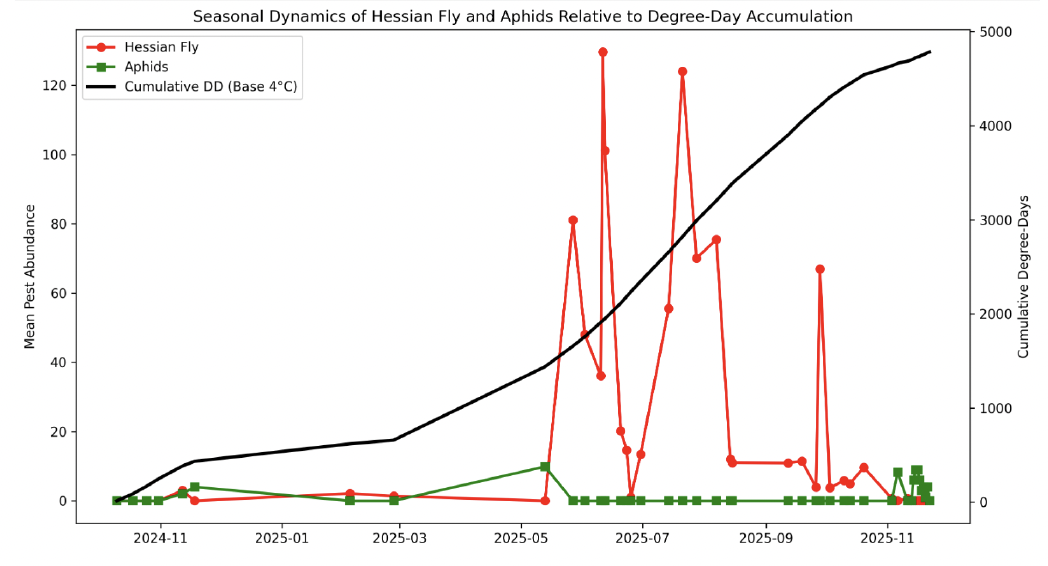
Figure 1. Seasonal dynamics of Hessian fly and aphid populations in relation to cumulative degree-days (base 4°C).
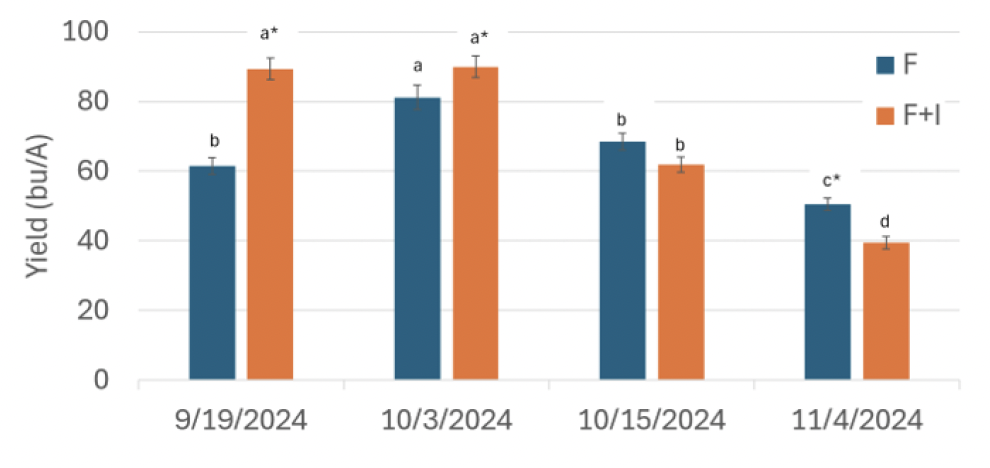
Figure 2. Effect of planting date and seed treatment on wheat yield (bu/A), comparing fungicide-only (F) and fungicide + insecticide (F + I) treatments. Different letters indicate statistically significant differences (ANOVA, Tukey’s HSD, p < 0.05).
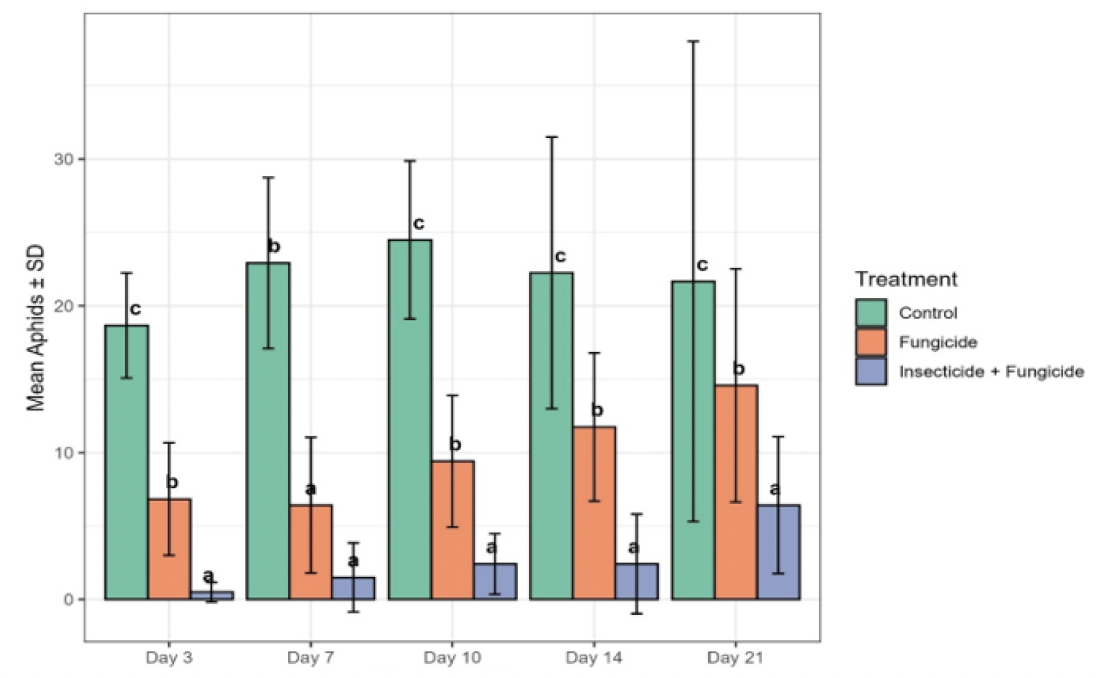
Figure 3. Effect of seed treatment on aphid populations in wheat over time. Different letters indicate statistically significant differences within each day (ANOVA, Tukey’s HSD, p < 0.05).
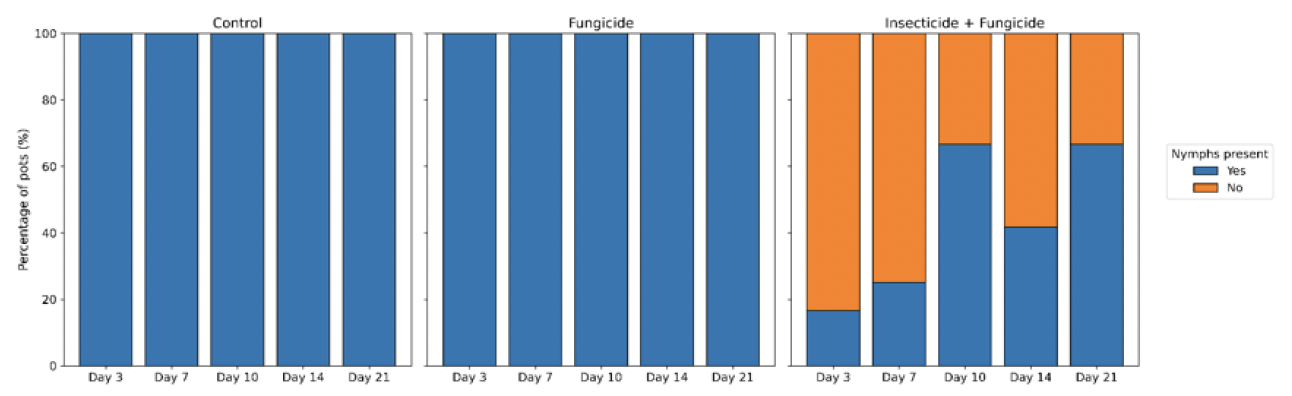
Figure 4. Percentage of plants with aphid nymph presence across treatments and observation days.
References
Adewinle, A., Villanueva, R., 2025. Hessian Fly Threat Persists in Kentucky Wheat Fields Ahead of 2025 Fall Planting. Kentucky Field Crops News, Vol 1, Issue 10. University of Kentucky, October 10, 2025.
Buntin, G. D. (2025). Hessian Fly (Diptera: Cecidomyiidae) Management Using Seed Treatments in Winter Wheat1. Journal of Entomological Science, 60(1), 129-140.
Bajwa, A. A., Farooq, M., Al-Sadi, A. M., Nawaz, A., Jabran, K., & Siddique, K. H. (2020). Impact of climate change on biology and management of wheat pests. Crop Protection, 137, 105304.
Deutsch, C. A., et al. (2018). Increase in crop losses to insect pests in a warming climate. Science, 361, 916–919.
Buntin, G. D., & Bruckner, P. L. (1990). Effect of planting date on Hessian fly infestation and production of triticale.
Perkins, C. M., et al., (2018). Impact of insecticide seed treatments and foliar insecticides on aphid infestations in wheat, incidence of barley yellow dwarf, and yield in West Tennessee. Journal of Economic Entomology, 111(6), 2734-2740.
Royer, T. A., Giles, K., Elliott, N. C., & Zarrabi, A. A. (2020). Small grain aphids in Oklahoma and their management.
Skendžić, S., et al. (2021). The impact of climate change on agricultural insect pests. Insects, 12, 440.
The original research file can be downloaded here.
The KY Small Grains Promotion Council is proud to sponsor research that covers real-world issues important to Kentucky farmers.