
Fall 2026 Wheat Planting Decision
Fall 2026 Wheat Planting Decision
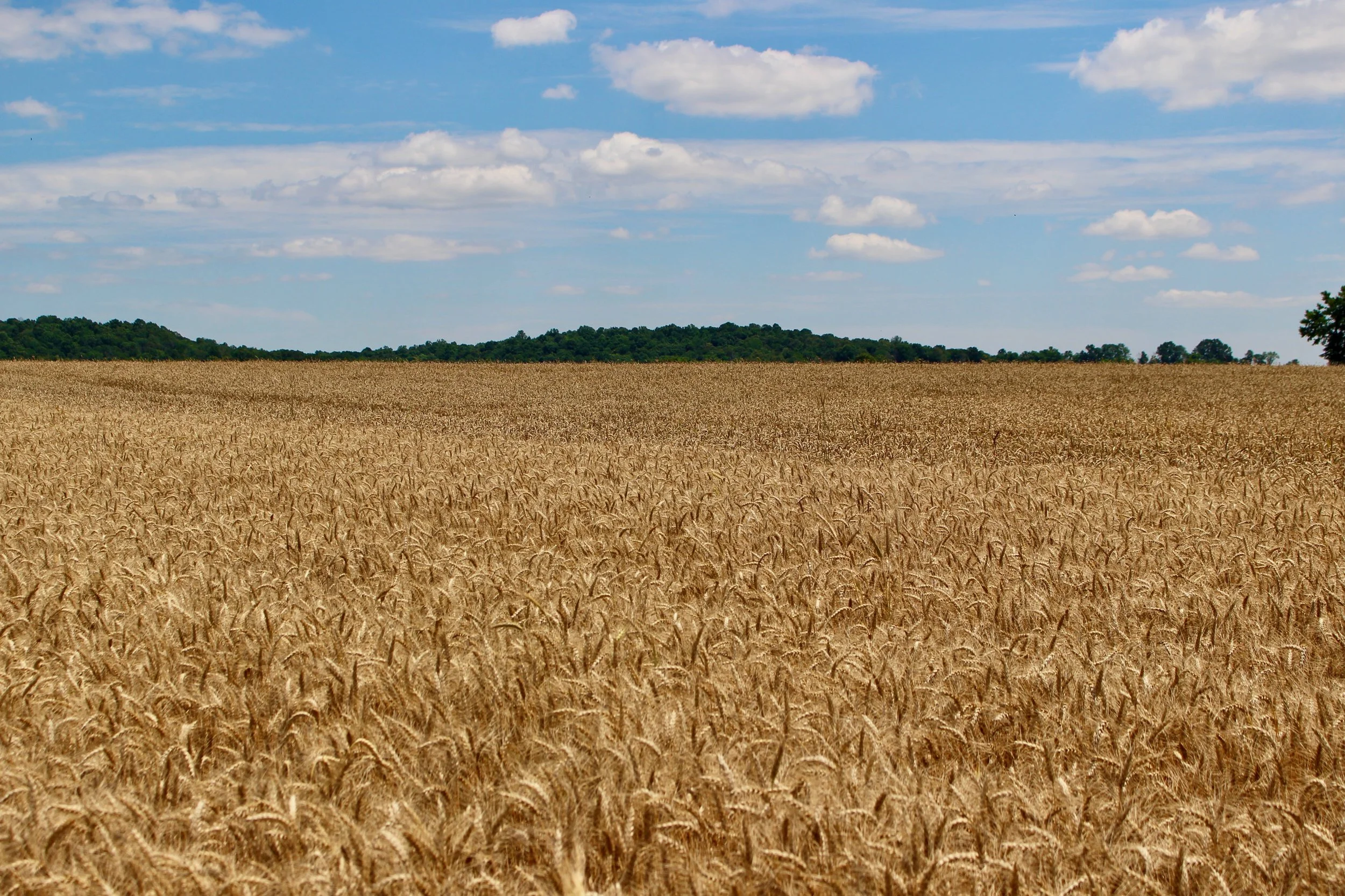
Photo credit: Camryn Manion
By Greg Halich, Associate Extension Professor, University of Kentucky
Corn harvest is underway and Kentucky grain farmers will soon decide if and how much wheat they will plant this fall. Compared to last year there is a sharp increase in both soybean and wheat prices, but also sharp increases in fuel and fertilizer prices. The following analysis quantifies these relative changes to estimate the profitability for crops harvested in 2027. The analysis includes estimated returns comparing double-cropped wheat/soybeans with full-season soybeans for the 2027 crop, and the likely implications for Kentucky grain farmers.
Additional costs associated with double-cropping are accounted for, including fuel, fertilizer, herbicides, machinery repairs and depreciation , labor, hauling, etc. The analysis assumes a blended mix of selling directly from the field and selling from storage for both wheat and soybeans, as well as expected basis for each crop with those scenarios. This results in 2027 crop blended prices of $7.15/bu for wheat and $12.65/bu for soybeans given Future’s prices at the close of 9/25/26.
Two regions with different agronomic characteristics are evaluated. The first region is along the southwest tier of counties roughly between I-24 and I-65, which traditionally does a lot of double-cropping. The second region is the northwest tier of Kentucky counties (Ohio Valley region) that has some of the best yields for corn and soybeans, but traditionally plants less wheat. Cash rent is assumed to be $200/acre for both these regions for the average ground and $250/acre on the best ground (note: this will vary substantially, but is done here for illustrative purposes only). Other major assumptions are: $5.75/gallon fuel, 50 mile one-way grain hauling, $.70/unit N, $.70/unit P, and $.42/unit K.
Southwest Tier Assumptions (Average Ground):
77 bu wheat
46 bu double-cropped soybeans
55 bu full-season soybeans
Resulting net profits (per acre):
+ $39 double-crop
+ $76 full-season soybeans
This results in a $37 difference in favor of full-season soybeans. The double-cropped soybean yield would have to increase to 49 bu before the double-crop was as profitable.
Southwest Tier Assumptions (Best Ground):
95 bu wheat
53 bu double-cropped soybeans
62 bu full-season soybeans
Resulting net profits (per acre):
+ $191 double-crop
+ $109 full-season soybeans
This results in a $82 difference in favor of the double-crop.
Northwest Tier Assumptions (Average Ground):
70 bu wheat
46 bu double-cropped soybeans
55 bu full-season soybeans
Resulting net profits (per acre):
- $7 double-crop
+ $76 full-season soybeans
This results in a $83 difference in favor of full season soybeans. The double-cropped soybean yield would have to increase to 53 bu in this case before the double-crop was as profitable.
Northwest Tier Assumptions (Best Ground):
80 bu wheat
53 bu double-cropped soybeans
62 bu full-season soybeans
Resulting net profits (per acre):
+ $92 double-crop
+ $109 full-season soybeans
This results in a $17 difference in favor of full season soybeans. The double-cropped soybean yield would have to increase to 55 bu in this case before the double-crop was as profitable.
Summary-Recommendations: Given the current expected market conditions (9/25/26), planting wheat looks attractive only on the best ground in the Southwest tier of Kentucky. On average ground in the Southwest Tier and Northwest Tier there is a clear advantage for full-season soybeans. On the best ground in the Northwest Tier there was a slight advantage for full-season soybeans. Only on the best ground in the Southwest Tier was there was a clear advantage for the double-crop. The overall profitability results are much better compared to last fall for both wheat and soybeans.
This analysis does not account for potential payments from Farm Bill programs. However, these programs would pay on base acre crop allocation and not planted acres, so there should be no effect on the planting decision. This analysis also does not account for the potential of harvesting straw, which is typically more common in Central Kentucky, or potential soil health benefits for having a winter cover crop with the wheat.
To change the assumptions above to your specific conditions and evaluate your expected profitability, go to the budget site at https://agecon.ca.uky.edu/extension/publications-budgets-decision-aids The Corn-Soybean Budgets and Wheat Budgets can be downloaded or opened directly from this page.
Greg Halich is an Associate Extension Professor in Farm Management Economics for both cattle and grain production and can be reached at Greg.Halich@uky.edu or 859-257-8841.
Halich, Greg. “Fall 2026 Wheat Planting Decision.” Economics and Policy Update 26:9, Department of Agricultural Economics, University of Kentucky, September 29, 2026.
Author Contact Info