As Kentucky producers begin to decide their planting intentions for the next growing season, current grain markets favor a wheat, double-crop soybean rotation over full-season soybeans.
Read More
What's Happening?
As Kentucky producers begin to decide their planting intentions for the next growing season, current grain markets favor a wheat, double-crop soybean rotation over full-season soybeans.
Read MoreToday, the U.S. Department of Agriculture (USDA) announced a second round of coronavirus relief payments which extends eligibility to additional classes of wheat. The new $14 billion package now covers producers of all classes of wheat. These add to the durum and hard red spring (HRS) wheat classes which were covered under the first round of the Coronavirus Food Assistance Program (CFAP).
Read MoreView the SRW havest and quality reports from the US Wheat Associates.
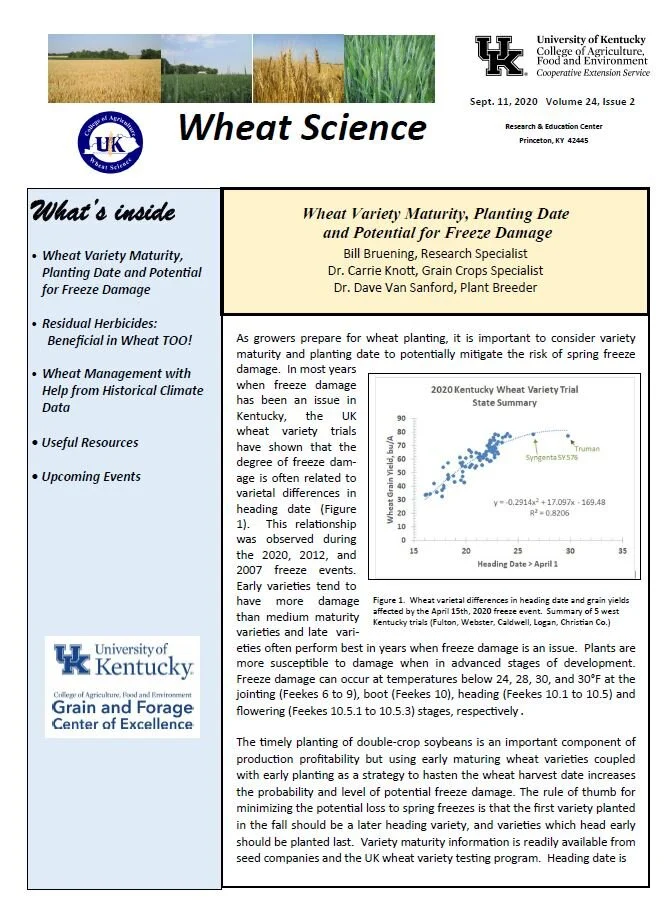
Read MoreRead the latest news from the UK Wheat Science Group. This newsletter includes articles on wheat variety selection, residual herbicides, wheat management using historical climate data, and other useful resources.
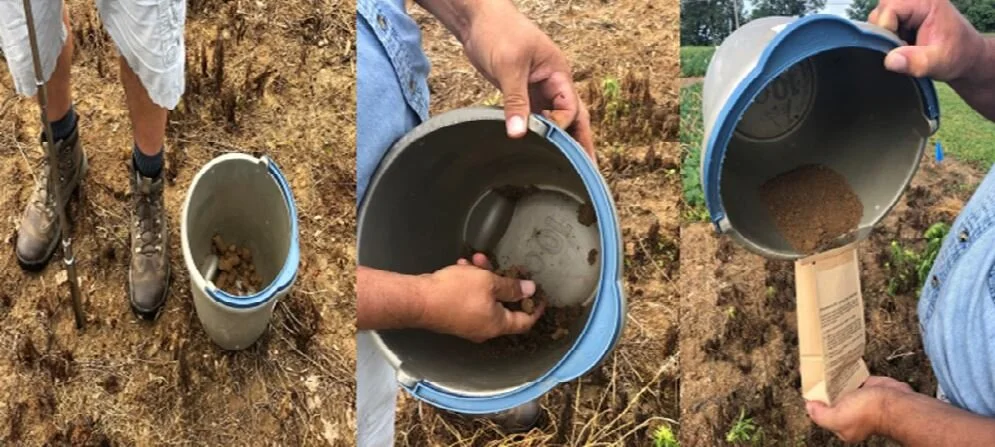
Read MoreFertilizer applications can influence the overall yield and profit of crop production systems. Phosphorus (P), potassium (K), and lime additions for winter wheat production should be based on a good soil sampling and testing protocol. A soil test is recommended every two years or less, depending on the crop rotation and individual field knowledge.
Read MoreThe Kentucky Small Grain Growers and Walnut Grove Farms are proud to announce the recipients of the Don Halcomb Memorial Scholarships for Community Leadership Through Agriculture, Mattie Mink and Ethan Robey.
Read MoreThe U.S. Department of Agriculture’s National Agricultural Statistics Service (NASS) released the July Crop Production report today, showing the yield forecast for Kentucky wheat was 63 bushels per acre, down 13 bushels from last year.
Read MoreIt has been about eight days since the May8/9 freeze occurred. This is about the minimal time needed to begin seeing initial freeze damage. At this point, a fairly accurate assessment of damage should be able to be made, but as days progress the damage will become much more evident.
Read MoreThe Kentucky Small Grain Growers Association is proud to announce the availability of the Don Halcomb Memorial Scholarship for Community Leadership through Agriculture for the 2020/2021 school year.
Read MoreSome of the early-planted wheat and even some wheat planted ‘on time’ within the first two to three weeks of October is beginning to head. This is quite concerning given how early in the spring it is.
Read MoreThis spring, grain producers across the Midwest, including those in pockets of Kentucky, are dealing with grain quality issues in storage bins that are causing problems during unloading.
Read MoreThe University of Kentucky’s IPM Training School is scheduled for March 12 at the UK Research and Education Center in Princeton.
Read More
Winners of the 2019 Kentucky Wheat Yield Contest were honored January 16, 2020 during the Kentucky Commodity Conference.
Read MoreIn 2017 two separate populations of Italian ryegrass from Kentucky were submitted to the University of Kentucky weed science program for screening of herbicide resistance. The two populations were screened for resistance in greenhouses at the University of Kentucky Research and Education Center in Princeton in the winter of 2017-2018.
Read MoreBarley yellow dwarf is one of the most devastating diseases in wheat worldwide. Here, we report the absence and presence of plants infected with BYDV or CYDV in commercial wheat fields in western Kentucky.
Read MoreCommercial winter wheat seed (cv Pioneer26R1A) without and with insecticide seed treatment (Poncho® (clothianidin)) were planted into no-till research plots of the University of Kentucky’s Research and Education Center in Princeton, KY.
Read MoreResearch by Tim Phillips at University of Kentucky.
Read MoreCereal rye is planted on more acres than any other cover crop species in the U.S. because it can reliably produce substantial biomass in a wide range of growing conditions. In order to maximize these benefits, well-adapted cereal rye cultivars should be selected for rapid and complete ground cover, high biomass production, and high potential to suppress weeds.
Read MoreCorn Silk Farms of Logan County had the highest overall yield and highest No-Till Division yield in the commonwealth, achieving 126.88 bu/A using AgriMaxx 485 seed.
Read MoreGrower survey will help shape the future of wheat extension tools. The Wheat Initiative’s - Agronomy Expert Working Group is trying to better understand how knowledge mobilization and technology transfer tools can be adapted to meet regional needs in a digital world.
Read More